November Six Oscar Lima

Month: May 2024

Buzz-B-Gone!

Last week, PG&E finally sent a team of RFI hunters out, who agreed with my assessment regarding which pole seemed to be the trouble, and this week they had a crew out to replace the high voltage section of the pole:
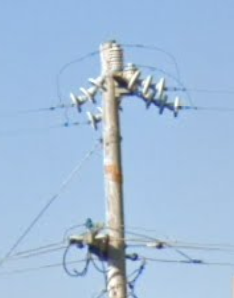
The top of a utility pole featuring antiquated, sagging insulators.

The “before” picture- now it’s obvious how the insulators were sagging.
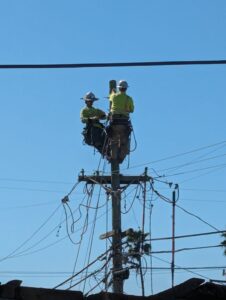
The offending crossbar and insulators removed by a crew.
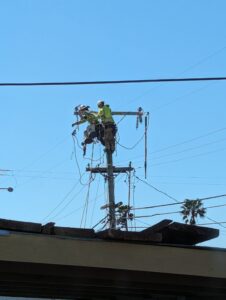
Placing the new crossbar and insulators.
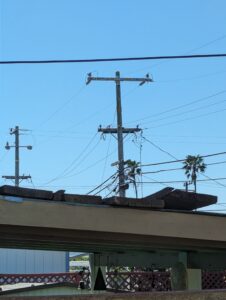
Job done!
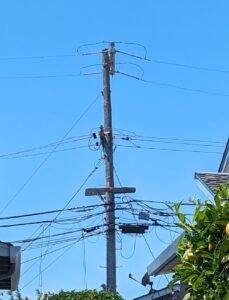
The “after” picture; note how much further away from the pole these insulators keep the wiring

The RFI crew, once PG&E management finally relented in sending them, was very friendly, personable, and professional.  They did a great job in confirming my suspicions and told me one of them was even able to hear arcing coming from that pole while standing underneath it.  They reported back their findings, and a crew arrived this Tuesday to actually rebuild the top of the pole.  This crew was fascinating to watch- so efficient, and they did such a nice, clean job of reworking that pole.

Here we can visually see the buzzing come to an end when power was shut down and the top of the pole was replaced:
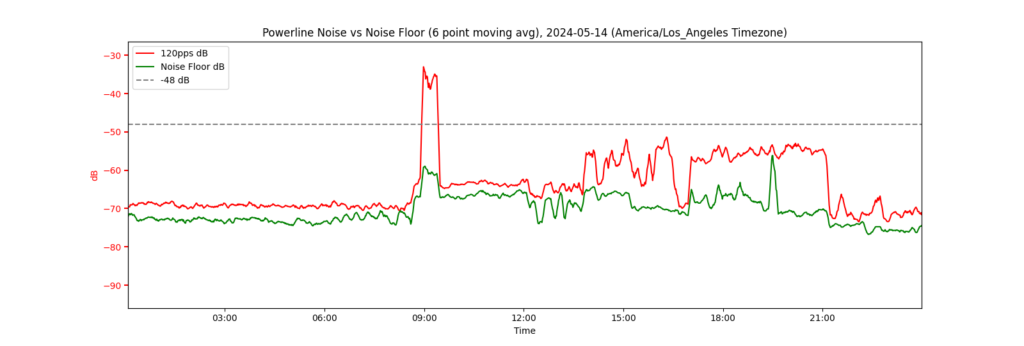
Just after 9 AM, it’s gone, hopefully for good, and with also a reduced risk of fire, damage to property, or someone getting hurt.  Unfortunately, this exercise also revealed a secondary source of interference, which is further away and picked up in the early afternoon.  This one is proving more difficult to track down; from the bearings I’ve been able to get so far, it appears to originate inside the PG&E Poplar Creek substation.  It’s also more intermittent, so I suspect it’s going to be more tricky to trace:
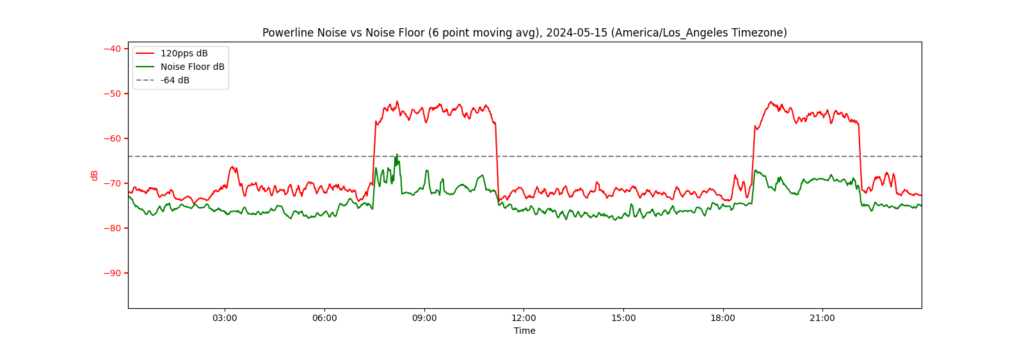
Data collected so far would seem to indicate that this is more of a mid-morning and early evening noise.  Because it’s further away, it’s a little more difficult to get a fix on its location, but I was able to get a collection of points yesterday evening:
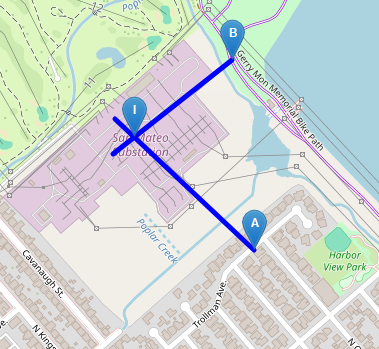
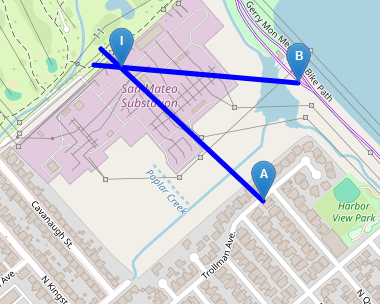
The area immediately around the Poplar substation is inaccessible to the public, so the best I could do was take a few readings from the closest I could get on public property.  Note that there’s considerable uncertainty around the real origin of the noise; my antenna is directional, but the main lobe is still up to 30 degrees wide, and my headings are approximate, provided by a tool on my phone and an approximation of the direction my antenna was facing- they could all be off by a few degrees.  Thus the real noise source could plausibly be anywhere in a 20 meter radius around these intersection points.

Unfortunately, PG&E wants me to start the entire process over again for the secondary source, so I’ll have to close out the original case, and open a new one now, which means probably another 60 days of dealing with this secondary noise before they send someone out again.  At least being further away and less persistent, it’s somewhat less bothersome.

It’s kind of astounding how this utility doesn’t monitor these things on its own and drags its feet so aggressively in dealing with them when they’re reported.  Once they actually relented in getting a crew out to investigate, the first problem was identified and resolved very quickly.  It would stand to reason that they might want to proactively look for things arcing inside a substation…
Vindicated!

After getting connected with their comm techs a couple days ago, PG&E finally came out today (58 days after I opened my original ticket). And to give them credit, their crew was very knowledgeable and personable once I was finally able to get someone out here.
 
They managed to get access to the suspect pole, and just came back by after their noise hunting expedition to tell me they agree with me- it is that pole. One of the guys could even hear it arcing while he was standing underneath it.
 
They’re going to have a crew come out and “rebuild” what’s on that pole. No ETA, but at least we’re on a path to resolution.
 
This effort plausibly prevented a fire, property damage, or someone getting hurt. Also, I am not crazy! (Or at least not about RFI.)

I Have Located The Buzz

I expected that this morning, when the humidity dropped and the sun came out, the buzz would start up again, and it did.  This afforded me an opportunity to go out and try my direction-finding skills again with the Yagi and the HT.

This time, determining which pole it was with certainty was easy.

I set out to try both aiming the main lobe of the Yagi at a pole and then turning it 45 degrees to the null in the antenna pattern.  (I drew the 45 degree angles on the beam with a sharpie.)  The nulls in the pattern are about half as wide as the main lobe, meaning I could get better selectivity by looking for where the signal went away rather than where it was.

This turned out to be successful.  As it happened, there was a location on the sidewalk where turning 45 degrees to the left would put one pole in a null while pointing directly at the other pole.  And on my first try, I quickly determined which pole it was; it dropped into the null and that was it… nothing came even off the main lobe from the other pole.

From where I was standing, I had to point the antenna up some to pick up the buzz, so I was pretty sure it was coming from the pole in front of me and not one further away but in the same direction, but nonetheless, I walked around to the next block over just to make sure, and indeed, I had to turn 180 degrees to face where I had been standing to keep picking up the buzz.

I then called PG&E and had them add to the ticket that I’ve had open for the last 52 days the precise location of the pole from which the noise emanates.  I have now done more than half the work for them: I can tell them the conditions under which they’re likely to be causing interference, the time of day it’s most likely to be present (4 PM), and show them charts of when it has started and stopped and varied throughout the day.

The culprit pole is indeed along the powerline run that also runs behind our house which has already had multiple insulators replaced because of catastrophic failure.  I’m not letting PG&E off the hook until they fix this, because otherwise we’re almost certainly going to have wires down in someone’s back yard again, likely another pole fire, and someone could get seriously hurt or property could be damaged.  If that happens, all this data I’ve collected, all the information I’ve given PG&E, all the times I’ve warned them that this could be a serious problem, becomes somebody’s Plaintiff’s Exhibit A.

Direction Finding The Buzz

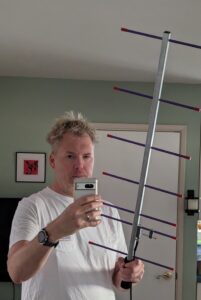
A tired looking guy holds up a Yagi antenna

I AM IN RADIO CONTACT

W1EMI at the ARRL suggested that if I had a handheld Yagi and an HT that can demodulate AM on UHF, it could be very helpful to do some direction-finding and narrow it down to which pole is causing the trouble.  I didn’t have a Yagi before, but I have one now.

After assuring my neighbors that I’m not from space or anything, I walked around trying to pinpoint the noise tonight.  The noise itself was not very cooperative, being somewhat intermittent in the gusty winds, but I was able to narrow it down to two potential poles, and neither one was the one I originally thought it was.  I suspect this is why switching to UHF can really help.

Unfortunately both poles are in other people’s back yards (and just a few houses away from ours) and the main lobe of the antenna is just wide enough that with an intermittent sound, I can’t quite discern for certain which pole it is.  I suspect with a more constant sound I would be able to tell a little bit better, and a constant buzz might be enough to heat up an insulator so it shows up on a thermal image.

Noteworthy is the fact that both of the suspect poles are part of the same run of wire on which there have been two catastrophic insulator failures in the last three years, both of which resulted in powerlines down in people’s back yards and small pole fires.  Thus it would be irresponsible of me to let this go and not make PG&E fix it.


© 2026 N6OL

Theme by Anders NorenUp ↑