I’ve found that when someone tries to convince you that something is anything except what it appears to be at face value, they’re gaslighting you. Or as I sometimes call it, “Occam’s Knife Game” in which the player stabs around at every possible explanation except the simplest one, and in so doing reveals that they know what that explanation really is — it’s the one they’re avoiding.
In our latest episode, PG&E actually put forth some minimal effort for a change and sent some techs out to go noise hunting. Note that we’ve been down this road before, and they affirmatively located a noise source within the Poplar Street substation. This time their motivation in signal hunting appears to me not to have been for the purposes of actually locating the source of their noise, but rather to find something — anything — else they can blame the interference on.
From their hunting efforts, PG&E believed they’d found the “real” culprit, a cable TV service amplifier giving off spurious emissions on 30 MHz, and I was asked to see if I could confirm whether this was the same noise I was hearing at my station. There are a few problems here already: I’m not monitoring or trying to use 30 MHz — that’s not even in an Amateur Radio band — and the type of noise I’m receiving is not the kind you’d normally expect to hear from a switching power supply or from spurious emissions from a cable TV amplifier. I am receiving, and specifically monitoring for, 120 pulse-per-second arc noise, the kind of noise you’d get if the two peaks of a 60 Hz current were arcing to a ground wire or grounded object. (My monitoring software watches 3.540 MHz and specifically cross-correlates the time-domain signal looking for a 120pps noise. It will not easily identify other types of signals that don’t match this pattern.)
So I went out, again tonight, this time looking for this cable amplifier. I was not able to locate it where PG&E asserted it could be found. I did detect a “birdie” signal in the general vicinity of its supposed location at about 2300 Hz, but again, this is not the noise that’s causing interference at my station and not the noise I’m monitoring.
But while I was out hunting for this mysterious cable box, I did find a utility pole making a hellacious, buzzing racket. I hadn’t noted this before, but it’s immediately next door to the pole that I reported back in 2024 (and which PG&E actually fixed a few months later).
Then I went to stand in the middle of the street with the cable box’s alleged location to my left and the substation in front of me, 90 degrees to each other. If the true source of the trouble was the cable box, this would be a perfect location to tell whether the noise was coming from in front of me, or to my left, a vantage point not available from my station location, where the alleged cable box would have been more or less behind me with the substation in front of me.
And guess what: no noise to the left, plenty of noise to my front (and lots of noise to 45 degrees from the aforementioned pole). Shocking. Interestingly, the noise I pick up on 220 MHz is more of a very strong “white noise” type of emission now, not so much a buzzing. More on that later.
For the sake of completeness, I then headed out to the Bay Trail and north to the Poplar Creek pump station. This is as close as someone can get to the PG&E Poplar Substation while remaining on public land. I’ve been here before, many times, for the same reason: to reconfirm that I’m not crazy, and that the substation is really where the signal is coming from. You can probably guess the rest: yep, there’s a strong emission coming from the substation on 220 MHz. Exactly where I’ve been finding it for the last two years and exactly where I’m likely to find it again tomorrow, and next week, and at this rate, in another two years. Here I did pick up some buzz along with the white noise.
Much like my effort at the first location, here, too I found another utility pole producing a massive amount of RFI, this time one adjacent to Poplar Creek. There are actually two poles on opposite sides of the creek here, and because of thick vegetation and this area being known to harbor rattlesnakes, I opted not to get sufficiently close to differentiate the poles at this time. I had detected some intermittent noise from this pole in the past, but nothing like what I heard tonight. I suspect that like much of PG&E’s aging infrastructure, this and the other pole I found tonight have just been degrading over time, and until they actually cause an emergency situation, PG&E is happy to simply ignore any maintenance.
I’ve captured my 220 MHz direction-finding and some audio recordings of the noise I observed on an annotated Google Map. Here’s a preview:
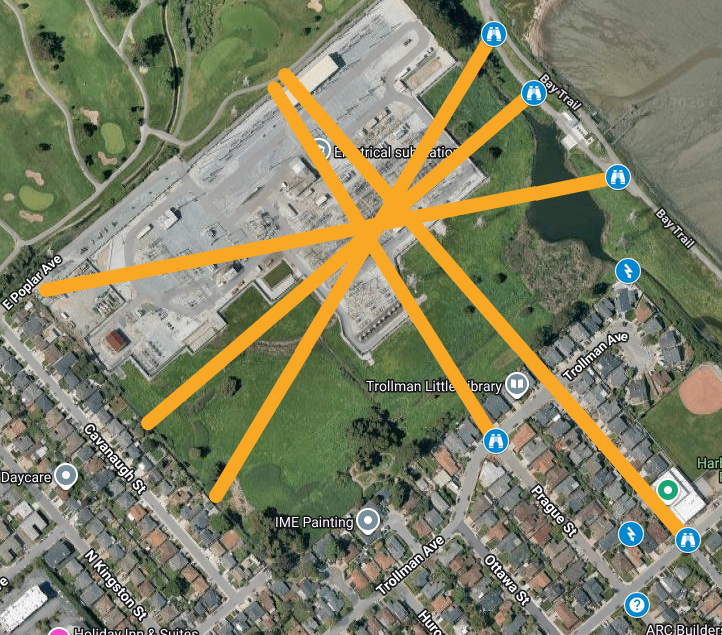
Gee, where could that 220 MHz emission be coming from?
To be completely scientific about it, I need to take another set of directional readings outside when there isn’t any notable interference, to prove a correlation (which I have also done before, but I’ll do it again for completeness). The RFI has been extensive and nonstop the entire day today, however, and even as I write this after 9 PM PDT, the noise is still S9+6. It will be necessary to get up quite early one morning, or to get lucky in the middle of the day for another set of observations.
The following morning, before the noise had started up yet, I ventured out again with my 220 MHz Yagi and, plot twist: there’s still a strong “white noise” emission coming from the substation. It would seem likely that this emission is not the same emission as the 120 pps emission plaguing 80 meters in my neighborhood, but is in fact something else entirely. I checked again with my 440 MHz Yagi and did not detect the same “white noise” emission, which suggests that whatever is producing this particular emission is more localized to the 1.25m band, or the 1.25m band is a harmonic of the band in which this noise originates. (This is why when we do a science, we need a control: it’s not enough to just measure when things are happening- we need to compare with measurements when things are not happening too.)
I’m less concerned about whatever is producing spurious emissions on 220 MHz, as I’m not active on this band, however this noise still doesn’t belong there (and it wouldn’t shock me if it is somehow related to a coworker consistently getting dropped calls on his phone when he runs by the substation).
To better differentiate between this emission of lesser concern, and the emission I’m actually looking for, I’ll be taking future measurements with my 440 MHz Yagi.
In their effort to try to convince me that the problem is everything except PG&E, what they’ve actually done is gotten is my finding found two very loud additional sources that weren’t consistently loud before.
As best as I can tell, something is still producing electrical-arc noise, and it’s not, as far as I can tell, a mysterious cable amplifier box that I’m unable to locate.
PG&E has now been dodging this problem for a few months shy of two years.